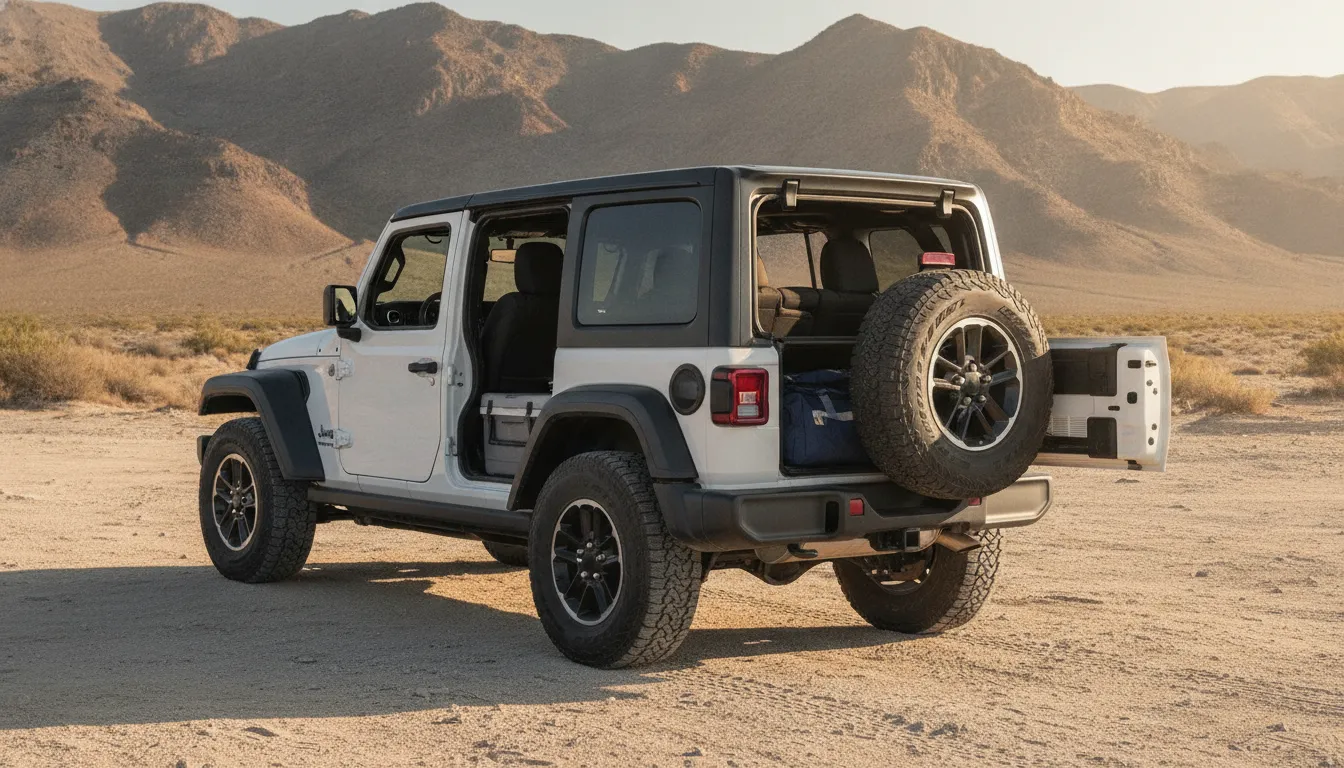
Jeep Wrangler cargo space depends on the body style you pick. A 2026 two-door holds 12.9 cubic feet behind the rear seat and 31.7 cubic feet with that seat folded. A 2026 four-door holds 31.7 cubic feet behind the rear seat and 72.4 cubic feet with the seat folded. Those published figures come from Jeep's cargo comparison and matching spec sheets, not from one truck on the lot.
See new Jeep Wrangler inventory in Barstow
Drivers between Barstow, Victorville, and the rest of the High Desert usually ask a simpler question. Will groceries, a cooler, and weekend gear fit while people are still sitting in back? The four-door answers that for most families. The two-door answers it only when you travel light or fold the rear seat for the whole trip.
Jeep Wrangler cargo space by body style
Jeep publishes two cargo numbers that shoppers often mix up. One is the space behind the rear seat with passengers still riding. The other is the maximum with that seat folded. Jeep's comparison lists the folded maximum: 31.7 cubic feet for the two-door and 72.4 for the four-door. Kelley Blue Book lists 72.40 cubic feet on 2026 four-door trims, and Edmunds lists 31.7, the four-door figure with the seat still up.
| Body style | Cargo behind the rear seat | Cargo with the rear seat folded |
|---|---|---|
| Two-door | 12.9 cu. ft. | 31.7 cu. ft. |
| Four-door | 31.7 cu. ft. | 72.4 cu. ft. |
Read the two-door row as a light-load cabin: two adults can bring a cooler and soft bags, and a bigger load needs the rear seat folded. Read the four-door row as the family layout: five people still have a real cargo hold, and folding the seat opens a weekend's worth of gear.
The four-door is not a slightly larger two-door, because the space behind the seat is more than double. Folding the seat widens that gap again. A trail-focused buyer and a family buyer can both want a Wrangler and still need different body styles.
Length tells the same story. Published 2026 exterior figures put the two-door at 166.8 inches long and the four-door at 188.4 inches long. Both are about 73.9 inches wide and 73.6 inches tall in the common spec. A longer wheelbase is what creates the extra cargo floor, not a taller roof.
Trim names do not change those base cargo volumes. Sport, Willys, Sahara, and Rubicon four-doors share the 72.4 cubic foot maximum in the published tables. A hardtop, a soft top, or a roof rack can change how you reach the load. It does not rewrite the cabin measurement. Confirm the body style on the window sticker before you compare two trucks that look similar in photos.
What fits behind the rear seat
Cubic feet are hard to picture in a parking lot, so a cooler, a grocery run, and a suitcase are easier tests. Use the seats-up number for any trip where people ride in back. Use the folded number only when that seat can stay down the whole way.
Two-door with people in back
At 12.9 cubic feet, the two-door cargo well is a day-trip space. It can take a soft cooler, a couple of grocery bags, and a backpack. It is a poor fit for two large roller suitcases while rear passengers stay seated. The rear opening is also narrow, and the spare tire lives on the tailgate, so wide boxes need a careful angle.
Rear legroom on the two-door is about 35.7 inches. That is enough for kids or shorter adults on a Barstow-to-Victorville drive. It is tight for a tall adult on a longer run toward San Bernardino. If those rear riders are regulars, the cargo number is not the only limit.
Four-door with people in back
At 31.7 cubic feet, the four-door can carry a week's groceries and a couple of carry-on bags without folding anything. Autoblog's luggage test of a four-door Unlimited used that same 31 cubic foot seats-up figure and found a usable, boxy hold. Wheel wells and structural pillars still narrow the floor, so a wide flat item can stop before the cubic-foot rating suggests it will.
Rear legroom grows to about 38.3 inches, and shoulder room stays near 55.8 inches. Five people fit, and the cargo behind them is finally large enough for a cooler plus soft bags. That is the layout most High Desert households actually need for school runs and weekend errands.
Shape matters more than the sticker
The Wrangler floor is tall and squared off, not a deep well like a crossover. A 40-quart cooler often fits upright in the four-door. The same cooler can crowd the two-door once a passenger's feet are back there. Soft duffels pack better than hard shells because you can press them around the wheel wells.
A full-size mattress does not fit flat in either cargo area with the seat up. A 75-inch TV box is also a bad bet unless the rear seat is folded and the box is narrow enough for the opening. Bring the actual item, or a tape measure, on the test drive. A published cubic-foot number cannot see a box spring or a TV carton.
Folded seats, removed seats, and the roof
Folding the rear seat is the normal way to get the big number. On the two-door, that move takes you from 12.9 to 31.7 cubic feet. On the four-door, it takes you from 31.7 to 72.4. You give up rear passengers to get that space. Plan the people first, then the gear.
The two-door's rear bench is a fold-and-tumble seat that can come out. Jeep's buyer's guide lists that removable bench, with fold-down headrests, as standard on the two-door. Removing it can open more floor than folding alone. It is a two-person job, and you need a place to store the seat at home. Do not count on doing it in a trailhead parking lot.
The four-door's 60/40 split is the more practical everyday feature. One side can fold for a long item while a passenger stays on the other side. That is how a fishing rod, a folded camp chair, or a narrow storage bin rides home without emptying the cabin. The published 72.4 cubic foot figure still assumes the whole seat is down.
Roof access is the Wrangler's extra trick, and it is also a cargo tradeoff. A soft top can come off, and a hardtop can come off in panels or as a whole. Open-air driving is the point for a lot of buyers around the Mojave. It also leaves cargo exposed to dust and sun unless you use closed bags. A roof rack moves bulky soft goods up top, but it adds wind noise and a climb every time you load.
Cargo anchors and a washout interior are standard on the Sport, according to Jeep's 2026 buyer's guide. Anchors matter more than they sound. A cooler that slides on a washable floor becomes a projectile on a bumpy section of trail. Strap it. The washout floor is genuinely useful after a dusty weekend, because you can pull the carpet and hose sand out instead of living with it.
Packing for High Desert weekends
A Barstow Saturday often mixes pavement and dirt. You might stop for groceries on Main Street, then point toward open desert, Fort Irwin traffic, or a cooler night off I-15. The Wrangler is built for that mix. The cargo plan still has to respect heat, dust, and the spare tire on the back door.
- Put water and a soft cooler low and centered, then strap them to a cargo anchor.
- Use soft bags along the wheel wells so the load stays below the rear window line.
- Keep a small recovery or first-aid kit where the front passenger can reach it.
- Leave the rear seat up if anyone is riding back, and measure long items before you fold.
- Shake out floor mats after dirt roads so sand does not grind into the carpet.
Heat changes what you should store, not the published cubic feet, because a closed Wrangler cabin in summer desert sun climbs quickly. Medicine, chocolate, and a camera should not sit loose on the cargo floor during a store stop. A light-colored soft bag and a cracked window while parked are basic habits on a Barstow afternoon, not optional extras.
Dust is the other constant. The Wrangler is not a sealed crossover, especially with the top off. Zippered bags beat open crates for clothes. A closed bin beats a cardboard box, because cardboard collapses once it picks up moisture from a cooler. If you run with the doors or top off, assume every soft surface gets a film of dust and pack accordingly.
The tailgate swing is easy to forget in a tight spot, and the spare tire adds real depth behind the bumper. In a crowded trailhead lot, or in a store lot along West Main, you need extra room to open the gate fully. If the space is short, you end up loading over a half-open door, which is awkward with a full cooler.
Passengers still come first on the highway. Rear headroom is about 41.7 inches in the common spec, and front headroom is about 42.6 inches. A roof rack loaded high does not steal that headroom, but it can raise the vehicle enough to matter in a low parking structure. Check height before you add a tall carrier.
How the four-door compares with other Jeeps
Cargo is one reason shoppers cross-shop Jeep models at Mojave Chrysler Dodge Jeep Ram. With the rear seats folded, Jeep lists 31.7 cubic feet for a two-door Wrangler and 72.4 for a four-door. A two-row Grand Cherokee reaches 70.8 cubic feet on a covered floor with a lower load height.
A Gladiator bed is listed at 35.5 cubic feet, which suits dirty or tall items that should stay outside the cab. These figures compare space. They are not a verdict on which vehicle rides better on pavement.
The four-door Wrangler and the two-row Grand Cherokee land near each other on maximum volume. They do not load the same way. The Grand Cherokee's floor is easier for strollers and groceries. The Wrangler's advantage is the removable top, the upright shape, and the ability to hose out the cabin. If your question is only about Grand Cherokee volume, the Jeep Grand Cherokee cargo space guide stays on that model.
The Gladiator is the other common fork. Its bed is listed at 35.5 cubic feet, which is less than a four-door Wrangler with the seat folded. The bed still wins for muddy gear, firewood, and anything you refuse to put on cloth seats. Trail manners are a separate decision. The Wrangler versus Gladiator trail guide covers that choice without repeating these cargo figures.
Shoppers who want maximum enclosed family space sometimes leave Jeep entirely. A Toyota Sequoia is a different cabin. The Toyota Sequoia cargo space guide covers that three-row layout. It is not a substitute for Wrangler measurements.
What to check on a Barstow test drive
Mojave Chrysler Dodge Jeep Ram of Barstow lists new Wranglers at 631 West Main Street. The mix on the lot changes, so check current new inventory instead of relying on a model named in a blog. Used Wranglers vary by year too. Sit in the one you would actually buy. A photo of an open cargo area hides the wheel wells.
Bring one bulky item from home. A cooler, a folded stroller, or the suitcase you use for a weekend is enough. Put it in with the rear seat up. Then fold the seat and try again. If the two-door only works with the seat folded, and you carry rear passengers every week, the four-door is the honest match.
Ask to see the top that is on that vehicle. A Sunrider soft top and a hardtop do not block the same way when you load a tall bag. Confirm whether the rear seat is a tumble bench you can remove or a split bench you only fold. That single feature decides how often you will use the maximum cargo number.
Look at the spare and the swing of the tailgate in the display row, not just on the spec page. Then check the front passenger floor. The center console and door bins take water bottles and small tools so they do not steal cargo space. Jeep lists cargo anchors and a full console as standard interior equipment on the Sport.
Pricing on the lot moves, so this guide does not quote a payment. If you are weighing a trade, start with the trade-in value tool before you talk numbers. If you want a monthly payment in view while you compare a two-door and a four-door, the Barstow financing application is the place to do that. Availability lives on the inventory pages, not in a blog.
Service is the other practical piece. Soft tops, hinges, and cargo-area trim take wear in desert use. When something in the cabin needs a look, contact the Barstow service team rather than guessing from a forum post. The contact page lists the current sales and service numbers.
Browse used Jeeps and other vehicles
Frequently asked questions
How much cargo space does a Jeep Wrangler have?
A 2026 two-door has 12.9 cubic feet behind the rear seat and 31.7 cubic feet with that seat folded. A 2026 four-door has 31.7 cubic feet behind the rear seat and 72.4 cubic feet folded. Jeep's cargo comparison publishes the folded maximums, and dealer spec sheets publish both figures.
Will a full-size mattress fit in a Jeep Wrangler?
A full-size mattress does not lie flat behind an upright rear seat, because the two-door opening is too short and too narrow. A four-door with the rear seat folded can take a folded camping pad, but a household mattress is the wrong shape for the tailgate. Measure the pad and try it on the vehicle you plan to buy.
Will a 75-inch TV fit in the back?
A 75-inch TV box is a poor match for either Wrangler with the rear seat up. The box is longer than the cargo floor and often wider than the opening between the wheel wells. Folding the four-door seat creates more length, yet the box still has to clear the tailgate and the spare-tire swing. Bring the carton, or its measurements, to the test drive.
What are the exterior dimensions in feet?
Published 2026 figures put the common two-door at 166.8 inches long, which is about 13.9 feet. The common four-door is 188.4 inches long, or about 15.7 feet. Width is about 73.9 inches and height is about 73.6 inches, before a roof rack or larger tires. Some 392 and Moab trims run longer and taller, so read the sticker for that truck.
How many suitcases fit in a four-door Wrangler?
With the rear seat up, plan on a few soft carry-ons or one large suitcase plus smaller bags in the 31.7 cubic foot hold. Two large hard suitcases fit more reliably with the seat folded. Wheel wells steal width, so soft bags pack better than rigid shells.
Does the roof come off without hurting cargo space?
Removing the top does not change the floor measurement. It does leave the load open to sun and dust. Use closed bags, and remember that a roof carrier is extra space, not a replacement for the cabin hold. The spare tire still swings out with the tailgate.
Is the two-door enough for High Desert driving?
Yes, if you usually travel with one other person and a light load. The 12.9 cubic foot seats-up hold is the limit. If kids, coworkers, or extra passengers ride along, the four-door's 31.7 cubic feet behind the seat is the layout that keeps gear off their laps.