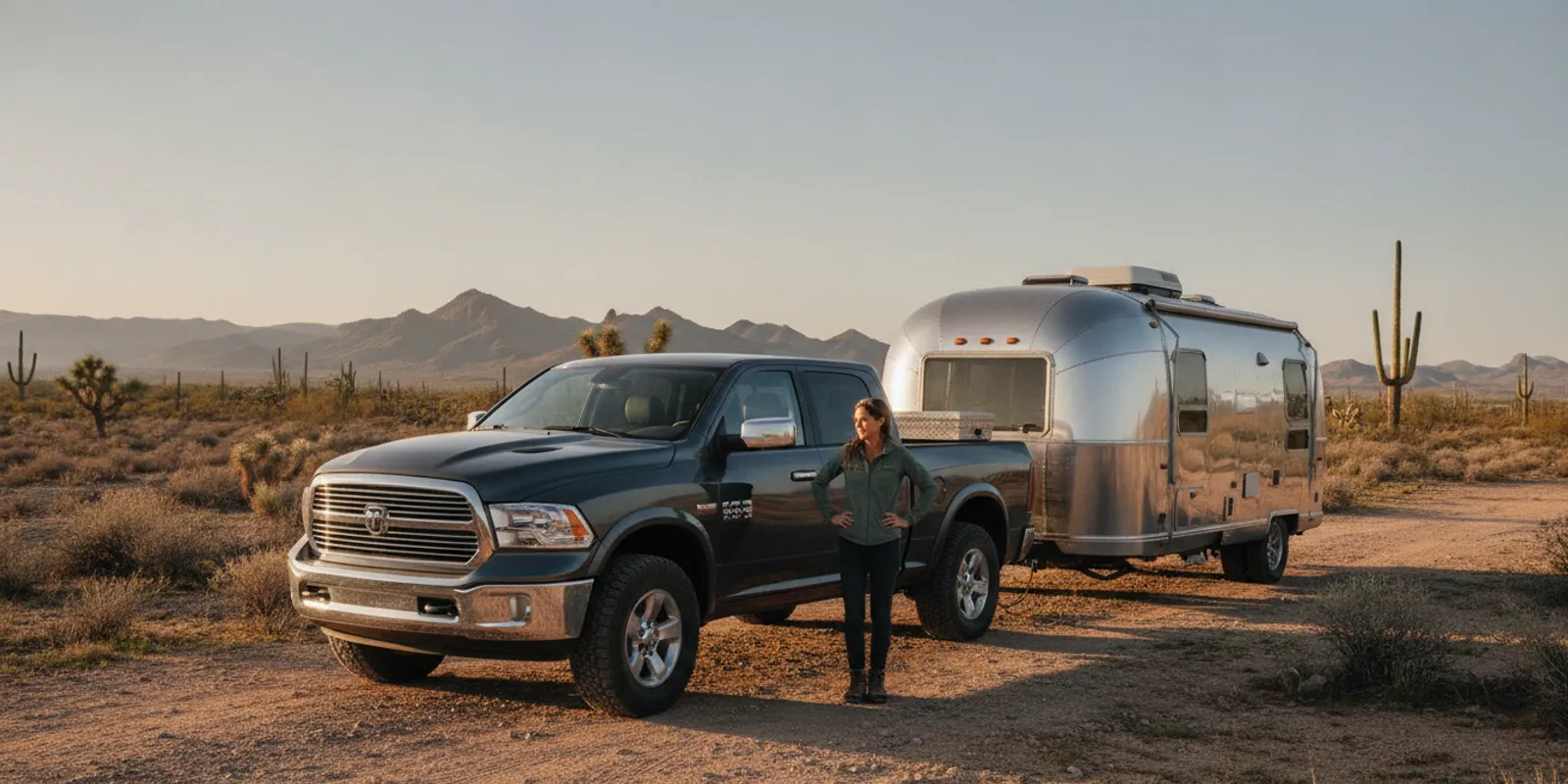
Ram 1500 towing capacity is not one fixed number for every truck. The rating can change with the engine, cab, bed, drivetrain, axle ratio, trailer equipment, and the weight carried inside the truck. If you are comparing trucks for a travel trailer, boat, utility trailer, or off-road gear in the High Desert, the safest starting point is to match the exact truck and trailer rather than rely on a headline maximum.
What does Ram 1500 towing capacity mean?
Towing capacity is the maximum trailer weight a particular vehicle configuration is rated to pull. It is not the same as payload, tongue weight, gross vehicle weight rating, or the rating of the hitch. Each number answers a different question, and the combination is only suitable when every relevant limit is respected.
- Towing capacity: the maximum trailer weight the truck is rated to tow.
- Payload: the weight the truck can carry, including occupants, cargo, accessories, and trailer tongue weight.
- Tongue weight: the downward force the loaded trailer places on the hitch and truck.
- Gross vehicle weight rating: the maximum loaded weight of the truck itself.
- Gross combined weight rating: the maximum combined weight of the loaded truck and loaded trailer.
A truck may have a high published tow rating but still be limited by payload once several passengers, tools, camping equipment, and tongue weight are added. That is why the useful question is not simply, “What is the biggest trailer a Ram 1500 can tow?” Ask instead, “What can this exact truck tow after it is loaded for my trip?”
Why can two Ram 1500 trucks have different ratings?
Ram 1500 models can be offered with different powertrains and configurations. A truck with one engine, cab style, bed length, drivetrain, axle ratio, and towing package may have a different rating from a similar-looking truck with another combination. Model year matters too, so a chart for another year should not be treated as the rating for the vehicle you are considering.
Engine and powertrain
The engine affects available power, but it is only one part of the rating. Transmission, cooling equipment, axle ratio, drivetrain, and the vehicle’s certification also matter. Do not assume that choosing a larger engine automatically gives the truck the maximum rating for every trailer. Confirm the rating for the exact year and equipment.
Cab, bed, and drivetrain
Cab size, bed length, rear-wheel drive, and four-wheel drive can change curb weight and the capacity available for passengers and cargo. A heavier configuration may leave less payload even when the model name and engine are the same. Think about the cab and bed you need for everyday use, then check its ratings rather than selecting on engine alone.
Towing equipment
A factory tow package may add equipment intended for trailer use, such as a receiver, wiring, cooling provisions, or a trailer brake controller. The hitch itself also has a rating. The truck, receiver, ball mount, ball, safety chains, tires, and trailer all need to suit the load. A strong truck rating cannot raise a lower-rated hitch or trailer component.
How should you calculate the trailer weight you need?
Start with the trailer’s actual loaded weight, not its empty or advertised dry weight. Water, propane, batteries, food, tools, spare equipment, personal items, and recreational gear all add weight. A family packing for a desert weekend may bring coolers, recovery gear, extra water, and camping supplies that were not included in the trailer’s empty figure.
- Find the trailer’s empty or shipping weight and its maximum loaded weight.
- List the equipment, supplies, fluids, and personal items you will add. Include gear kept in the truck as well as in the trailer.
- Weigh the loaded trailer when possible, using a certified public scale.
- Check the truck’s payload information on the driver-door label.
- Account for passengers, cargo, accessories, and trailer tongue weight against the truck’s available payload.
- Compare the actual combination with the truck’s towing, payload, hitch, tire, and combined-weight limits.
For a simple illustration, imagine a family choosing between a trailer’s advertised empty weight and the weight after packing. The empty figure can make the trailer appear comfortably within a truck’s tow rating. Once water, food, bedding, batteries, and bikes are added, the loaded trailer may be substantially heavier. The additional tongue load also uses truck payload. The family therefore needs to check both the loaded trailer weight and the truck’s remaining payload instead of stopping at the tow-rating comparison.
Tongue weight is part of the load carried by the truck. A trailer that is within the tow rating can still exceed payload if tongue weight, passengers, cargo, and accessories are too heavy together. Purdue Extension explains why the truck, hitch, and trailer numbers need to be considered as one combination in its guide to making sure truck and trailer ratings add up.
Which numbers should you verify on a Ram 1500?
Use information for the exact truck whenever possible. A general model-year chart can help narrow a search, but it cannot replace the vehicle label and manufacturer documentation. Before you rely on a number, identify where it comes from and whether it applies to the truck’s precise configuration.
- Driver-door certification label: check the gross vehicle weight rating, tire information, and occupant-and-cargo limit. The payload figure applies to that particular vehicle, not every Ram 1500.
- Owner’s manual: review towing tables, hitch guidance, trailer brake information, and restrictions for the configuration.
- Vehicle identification and build information: use the VIN or equipment details to confirm engine, axle, drivetrain, and installed towing equipment.
- Hitch label: verify receiver and tongue-weight limits, and whether a weight-distributing setup is required.
- Trailer label: check gross vehicle weight rating, axle rating, tire rating, and recommended tongue weight.
Ask for the specific tow-rating information before choosing a truck. A salesperson can help compare equipment with your trailer plans, but the final limits should come from manufacturer documentation and the labels on the truck and trailer. If a number is unclear, pause and verify it instead of estimating from trim name or appearance.
How do the main weight limits work together?
It helps to view towing as a set of simultaneous checks, not one pass-or-fail number. The loaded trailer must fit within the truck’s tow rating. The loaded truck, including the trailer’s tongue load, must remain within its vehicle rating and payload. The combined truck and trailer must remain within the combined limit. Components such as tires, receiver, ball mount, and trailer axles must also be suitable.
| Check | What to include | Why it matters |
|---|---|---|
| Truck payload | People, cargo, accessories, tongue load | Shows whether the truck itself is carrying too much |
| Trailer weight | Trailer plus fluids, supplies, and equipment | Compare the real travel weight with the truck’s tow limit |
| Combined weight | Loaded truck and loaded trailer | Checks the full combination against its combined limit |
| Hardware and tires | Receiver, ball mount, tires, trailer axles | The lowest applicable component rating still governs |
Think of the lowest applicable rating as the practical boundary. A high tow rating does not compensate for a payload shortfall; a suitable payload does not make an undersized hitch acceptable. If the figures are close, weigh the loaded combination and seek qualified guidance before traveling. Loading, tire condition, and trailer balance can affect how the setup behaves, so a paper comparison is only the beginning.
What trailer types can a Ram 1500 be used for?
The right configuration depends on the job. A small utility trailer has different needs from a loaded travel trailer or one carrying an off-road vehicle. These are use cases to evaluate, not a promise that every truck can handle every example.
Travel trailers
Travel trailers can create a substantial tongue load and catch wind on open desert roads. Consider loaded weight, tongue weight, length, brake system, weight-distribution requirements, and sway-control needs. Also think about how many passengers and how much gear will be inside the truck. A comfortable match leaves room for the trip rather than operating at a limit.
Boats and personal watercraft
Boat weight can include the trailer, fuel, batteries, water, safety equipment, and accessories. The ramp, parking surface, and road grade affect the task too. Confirm suitable wiring, mirrors, tires, and braking equipment for the complete load. Do not forget that the boat may be heavier when ready for use than when stored or transported empty.
Utility and equipment trailers
A utility trailer may look light when empty but become much heavier with landscaping material, construction equipment, motorcycles, or recreational vehicles. Know the cargo weight and secure it so it cannot shift. Keep the load within the trailer’s own axle and tire limits, and check that weight is balanced as recommended by the trailer maker.
Off-road and desert recreation
High Desert outings often bring extra fuel, recovery equipment, coolers, tools, spare tires, and camping supplies. Those items count against payload if they ride in the truck, and they add to trailer weight if carried there. Before leaving Barstow, account for people, equipment, and supplies in both parts of the combination. Make a list before loading so that heavy items do not quietly accumulate after the rating check.
How can you compare a Ram 1500 with your current truck?
Make a short worksheet before visiting a dealership. Record the trailer’s loaded weight, estimated tongue weight, coupler type, trailer brake setup, and gear normally carried. Note how many people travel with you, what stays in the bed, and whether four-wheel drive, a particular cab, or a certain bed length is important.
Then compare complete combinations, not advertised tow numbers. A truck with a lower theoretical maximum may be the better everyday fit if its payload and equipment match your actual needs. Conversely, a trailer plan that is likely to grow may call for more capacity or a different configuration. Do not choose based on an imagined future number without checking the particular vehicle you would buy.
For example, compare two shoppers. One takes a small, lightly loaded trailer on occasional trips with two occupants and little bed cargo. Another takes a larger travel trailer with a full family, bikes, coolers, and camping equipment. Even if both trailers seem close on a general chart, their payload demands differ. Their correct truck choice can differ too. The useful comparison is a trip-specific load list, not a single published maximum.
Shoppers can compare available new and used vehicle options with Mojave Auto Group and bring trailer information to the discussion. Mojave Auto Group represents RAM along with Toyota, Nissan, Jeep, Dodge, and Chrysler, so you can discuss your needs across the group’s brands without assuming every model has the same capabilities.
What should you check before a towing test drive?
A test drive cannot prove a truck’s maximum rating, but it can help you evaluate fit, visibility, controls, and comfort. Ask the dealership to identify the exact engine, axle, drivetrain, cab, bed, and tow-package details for the vehicle you are considering.
- Confirm that the door-label payload can accommodate your passengers and cargo.
- Inspect the receiver, wiring connector, mirrors, and trailer-brake controls.
- Make sure the hitch ball and mount match your trailer coupler and ratings.
- Ask how safety systems and camera views work when a trailer is attached.
- Discuss service access and inspection points to follow before a long trip.
- Take measurements if your trailer, garage, campsite, or parking area is a tight fit.
If you are comparing a new truck with a used one, review the vehicle history and inspect the hitch, frame, tires, wiring, suspension, and cooling system. Previous towing use does not automatically make a truck unsuitable, but it is a reason to ask questions and consider a professional inspection. Look for uneven tire wear, damaged wiring, visible hitch wear, and signs of repairs; have concerns assessed rather than treating a quick visual check as a complete inspection.
How can you prepare for a loaded weigh check?
A scale check is most useful when the truck and trailer are loaded as they will be for a real trip. Start by packing the normal passengers’ gear and filling the trailer with the supplies you expect to carry. Include full water or fuel only if that is how you intend to travel. Write down which items are in the truck and which are in the trailer so you can explain any difference between trips.
- Confirm that the scale can weigh the vehicle combination and follow its operator’s directions.
- Bring the truck, trailer, and load in their intended travel condition, with people accounted for as directed by the scale operator.
- Record the readings and compare them with each applicable label and manufacturer limit.
- If a figure is over a limit, remove or redistribute load only in a way that remains safe and within trailer guidance, then recheck.
- Keep the measurements with your vehicle notes and revisit them when passengers, trailer, or equipment change.
Moving cargo between the truck and trailer can change which limit is most important, but it does not make weight disappear. A lighter truck bed may reduce truck payload use while adding to trailer weight; moving items also changes balance. When adjusting a load, follow trailer-maker guidance and verify both truck and trailer ratings again.
What common towing mistakes should you avoid?
Many towing problems begin with an incorrect assumption about weight. Watch for these frequent missteps before you buy or set out:
- Using dry trailer weight: the trailer is usually heavier once equipped for real use.
- Ignoring payload: passengers, cargo, accessories, and tongue weight all use the truck’s available capacity.
- Checking only the truck: the hitch, tires, trailer axle, coupler, and brakes have their own requirements and limits.
- Overlooking tongue weight: a poorly balanced load can affect stability and control.
- Skipping a loaded check: compare the combination as you intend to travel, including fluids and gear.
- Assuming every model-year chart applies: confirm the exact vehicle and equipment.
- Forgetting maintenance: inspect tires, brakes, fluids, lights, straps, chains, and connections before departure.
Another mistake is treating a comfortable drive without a trailer as proof of towing suitability. A test drive can help you judge seating, sight lines, controls, and ride. It cannot confirm the loaded combination’s weights or replace the rating labels. Make those checks separately, then ask about any equipment or instructions you do not understand.
Frequently asked questions
Is Ram 1500 towing capacity the same for every model?
No. It varies by model year and configuration. Engine, cab, bed, drivetrain, axle ratio, equipment, and trailer setup all matter. Use the exact vehicle’s documentation rather than a single number for the whole model line.
Can a Ram 1500 tow a travel trailer?
It may be suitable, depending on the loaded trailer and the truck’s specific ratings. Check towing capacity, payload, tongue weight, hitch rating, trailer brakes, and combined weight together before deciding.
Does four-wheel drive reduce towing capacity?
It can change the rating because drivetrain equipment affects vehicle weight and configuration. Confirm the rating for the exact four-wheel-drive truck instead of applying a rear-wheel-drive figure.
Should I choose the maximum tow rating?
Not necessarily. Choose a combination with room for passengers, cargo, and the way you travel. A practical match is more useful than choosing a truck only for its largest published number.
Where can I compare a Ram 1500 for my towing needs?
Write down your loaded trailer weight and the people and gear you carry. Then contact Mojave Auto Group with those details to discuss available RAM trucks and other options in the High Desert.
What is a practical next step?
The best Ram 1500 towing capacity match is the one that fits your actual trailer, passengers, cargo, equipment, and travel conditions. Gather the labels and a realistic load list, then confirm the exact truck’s ratings before you choose or tow.