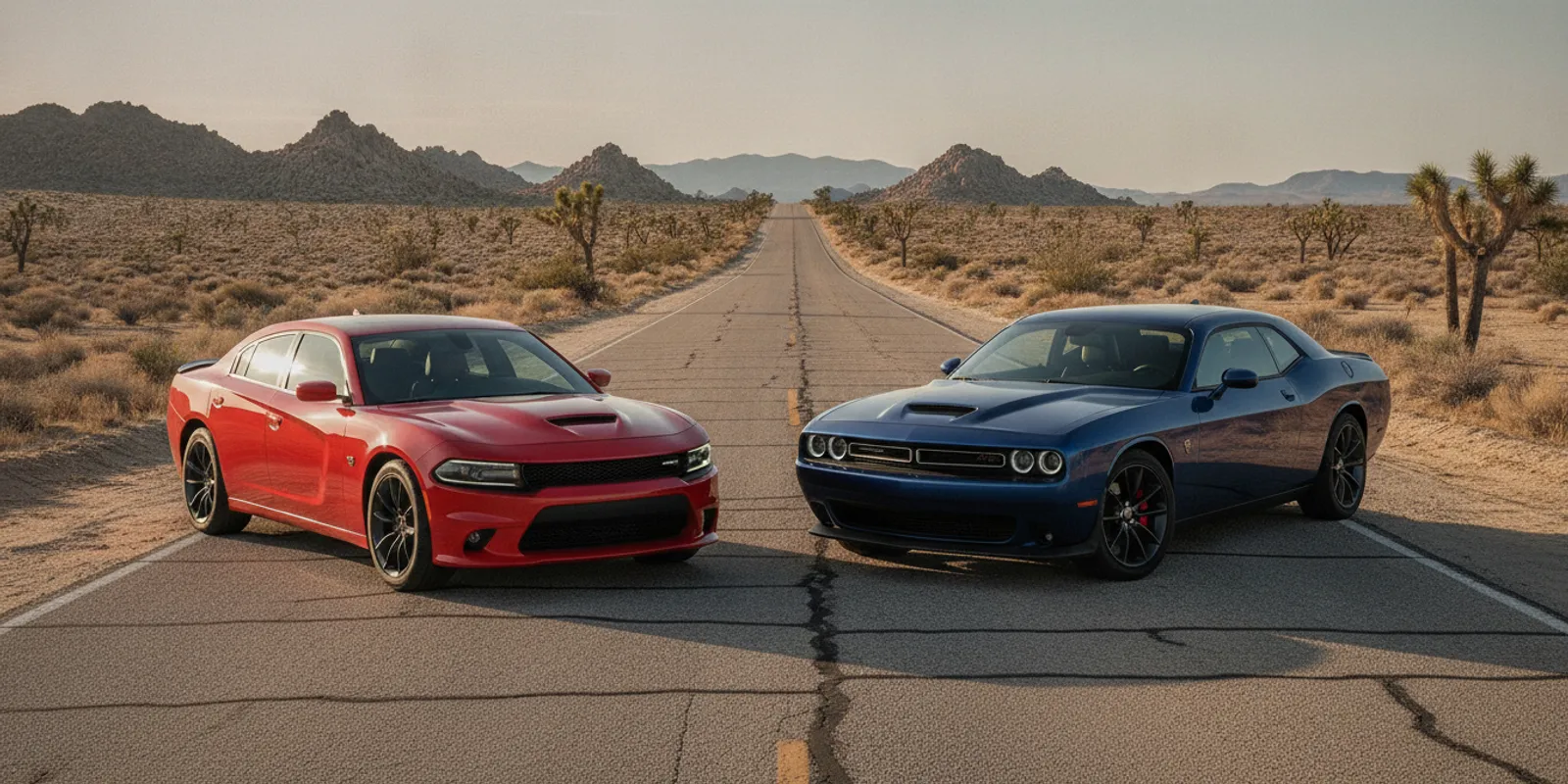
Choosing between the Dodge Charger vs Challenger starts with how you plan to use the car. The Charger’s four-door sedan layout and the Challenger’s two-door coupe layout create different daily experiences, especially when you carry passengers. Trim, model year, equipment, condition, and availability also matter, so compare the specific vehicles you can actually inspect rather than relying on a model name alone. For Barstow and High Desert shoppers, your usual passengers, commute, and budget are useful starting points.
What is the main difference between the Charger and Challenger?
The most straightforward difference is the body style. The Charger has been offered as a four-door sedan, while the Challenger has been offered as a two-door coupe. A sedan gives rear passengers their own doors. In a coupe, front-seat occupants generally need to move forward to let someone into the back. That distinction can matter more often than a styling detail if you regularly share the car.
The two designs also create different impressions from the driver’s seat and curbside. The Charger’s extra doors give it a more conventional passenger-car layout. The Challenger’s coupe shape may appeal to shoppers who prefer that profile and do not need frequent rear-seat access. Neither body style is automatically the better choice; it depends on which compromises fit your routine.
Do not assume that every vehicle carrying one of these names has the same engine, equipment, or features. Those details vary by year and trim. Confirm the exact model year and configuration on the vehicle you are considering, then compare those particulars rather than making a general comparison based on a badge.
How should passenger practicality affect your choice?
Think about a normal week, not just a special occasion. Who rides with you, how often do they use the rear seat, and do you need to load children or gear? A Charger’s four doors can simplify repeated passenger trips. If you rarely carry anyone in back, the Challenger’s coupe access may be a small inconvenience rather than a deciding issue.
Try the rear-seat routine
Open each door and practice getting into the back seat. Consider the height and reach required, how far the front seat needs to move, and whether the person climbing in can do so comfortably. If passengers include children, practice the steps you would take with a child seat: positioning it, securing it, and reaching the buckles. Bring the seat along if you need to confirm a specific fit. Do not rely on a general body-style description to answer a fit question.
Adults who ride in back should sit in each car if possible. Check headroom, legroom, seat comfort, and whether the seating position works for a short trip as well as a longer drive. A coupe can be perfectly workable for occasional passengers, but the person who rides there is the best judge of comfort.
Match the cargo space to what you carry
Consider groceries, work bags, sports equipment, luggage, or other items that are part of your actual routine. Look at both the space available and the shape of the opening. A bag may fit inside a trunk but be awkward to lift through its opening. If a particular item needs to travel regularly, bring it along or measure it before deciding.
Also think about how often you carry both passengers and cargo. A car that works well for a solo commute may feel less convenient when the whole household is traveling. Try a realistic loading routine instead of judging space only by looking into the trunk.
Which model suits your driving priorities?
Start by defining what you mean by a good drive. Some shoppers prioritize an easy daily commute, predictable controls, and a comfortable seating position. Others care more about the character of a particular engine or trim, the coupe profile, or the way a car responds on the road. These preferences are personal, and the specific year and configuration make a difference.
Compare the actual vehicle’s listed engine and equipment. Ask for clarification if a listing is incomplete, and verify that any feature important to you is installed on the car. Avoid inferring performance from a trim name or assuming that two cars with the same model name have identical specifications.
- Drive the route you expect to use: Include ordinary streets and a highway stretch if available. Notice ride comfort, seat position, visibility, and how the vehicle feels in traffic.
- Test the controls: Adjust the seat and mirrors, check the controls you use often, and see whether the layout feels clear without distraction.
- Notice low-speed usability: Consider parking, turning, and maneuvering in the places you visit. A car should feel manageable in the everyday settings that matter to you.
- Compare like with like: If possible, drive both vehicles on a similar route and under similar conditions. That makes it easier to distinguish the car’s feel from differences in traffic or road surface.
- Ask about running costs: Fuel use, tires, insurance, and maintenance can vary with model year, configuration, condition, and your driving habits. Get estimates for the specific vehicle and your situation.
For High Desert driving, consider both regular local trips and longer distances. Think about comfort in heat, how often you travel at highway speeds, and whether you will need to park in tight spaces. These are prompts for your own test drive, not claims that one model is right for every local driver.
How do the two body styles compare in everyday use?
This quick comparison is a starting point, not a substitute for checking a specific car. Model year, trim, condition, and features can change the details. Use the table to identify what you should test in person.
| Consideration | Charger sedan | Challenger coupe |
|---|---|---|
| Body style | Four-door sedan layout | Two-door coupe layout |
| Rear-seat access | Rear passengers have separate doors | Front-seat movement is typically needed for rear access |
| Potential everyday fit | Worth considering if you regularly carry passengers | Worth considering if rear passengers are less frequent and you prefer a coupe |
| What to test | Rear-seat comfort, cargo fit, visibility, and the exact trim | Rear-seat entry, cargo fit, visibility, and the exact trim |
| What to verify | Year, equipment, condition, history, and total cost | Year, equipment, condition, history, and total cost |
What ownership questions should you consider?
Purchase price is only one part of the decision. Compare the vehicle’s condition and records, estimate the expenses that matter to you, and check whether it fits your budget over time. A car with the layout and equipment you will use may be a more sensible match than one with features that do not fit your routine.
Review history and condition
For a used Charger or Challenger, ask what service records and vehicle-history information are available. Check whether the records appear consistent with the mileage and the current condition. Look at the tires, cabin, exterior, and areas that show wear, and ask about anything that is unclear. A qualified independent inspection can provide another perspective before you commit.
Check whether any open safety recall applies to the particular vehicle. The National Highway Traffic Safety Administration provides vehicle safety information and recall resources at NHTSA; use the vehicle identification details and follow the agency’s current recall-check instructions. A recall lookup is one part of evaluating a used car, not a substitute for reviewing its maintenance and condition.
Estimate the full cost, not only a payment
Before comparing two cars, write down the costs you expect to pay: purchase price, insurance, fuel, registration, routine maintenance, tires, and any work the car may need soon. Ask your insurer for a quote using the exact vehicle details. Fuel and maintenance estimates should reflect the particular model year and configuration as well as how far and how often you drive.
If you are comparing financing offers, review the amount financed, loan term, rate, and total amount paid, not just the monthly figure. A lower payment can result from a longer term and may not mean the vehicle costs less overall. Keep your budget consistent when comparing cars so a difference in financing assumptions does not obscure the vehicle comparison.
Confirm the year, trim, and equipment
Features and specifications can differ across model years and configurations. Confirm the vehicle identification details, trim, engine, mileage, and included equipment for each car. If a feature is important, ask to see it working or confirm it in the vehicle documentation. Verify current availability directly before making plans to visit, since inventory and model-year offerings change.
How can you compare two used examples step by step?
A simple, repeatable process makes a side-by-side decision clearer. Write down your requirements before you shop, then use the same checklist for each vehicle.
- Describe your everyday use. Note how many people usually ride with you, how often you use the rear seat, what you carry, and whether the car is mainly for commuting, family trips, or recreation.
- Set must-haves and acceptable trade-offs. Separate essentials—such as comfortable rear access or a feature you need—from preferences you can compromise on. This keeps styling or a single appealing feature from taking over the decision.
- Record the exact vehicle details. Write down each car’s year, trim, engine, mileage, listed equipment, and price. Ask questions where a listing leaves a gap. Do not assume the details of one example apply to another.
- Inspect the places you will use. Sit in the front and rear seats, try entry and exit, adjust the driving position, and check the trunk with your typical items in mind. Test controls and equipment that matter to your routine.
- Review records and condition. Ask about service and history information, look over the car, and consider an independent inspection. Check the applicable recall information through an official resource as part of your research.
- Drive both when possible. Use a similar route. Compare comfort, visibility, control feel, and how each car behaves in ordinary traffic. Do not rush the drive; make notes soon afterward.
- Compare total costs. Gather vehicle-specific insurance and ownership estimates, review the purchase figures, and make sure you are comparing the same assumptions for both cars.
How can you keep the comparison fair?
When the two cars are different years, trims, or mileages, make a note of those differences before drawing conclusions. A feature or driving impression may come from the particular example rather than the model as a whole. Put each car’s details on a separate page and use the same headings for both: seating, visibility, equipment, condition, records, price, and estimated ownership costs. Mark each item as confirmed, needs follow-up, or not important to you. This small step helps keep a memorable test drive from outweighing a more important practical concern.
Separate observations from assumptions. “The rear passenger needed the front seat moved” is an observation from your visit. “This trim always has a certain feature” is an assumption unless you have verified it for that vehicle. Ask for the vehicle’s documentation or test the feature directly. If the information is unavailable, leave it unresolved and decide whether you can live without knowing it before proceeding.
What should you do after each test drive?
Before starting the next drive, write down what you noticed while it is fresh. Record whether the seat and steering position felt comfortable, whether you could see clearly, how easy the controls were to use, and whether the car felt suitable for your ordinary route. Add a note about any sound, warning light, or condition concern that you want clarified. These notes are not a diagnosis; they are a way to remember what to ask and what to have checked.
If one vehicle feels more exciting but the other fits your passengers better, revisit your must-have list instead of making a rushed choice. Decide whether rear access is a daily requirement or an occasional compromise. Then consider the trade-off alongside cost, condition, and the likelihood that your routine will change. For example, someone who expects to carpool more often may give passenger access greater weight than a shopper whose trips are usually solo.
Do the same with the financial comparison. Use consistent assumptions for insurance, fuel, planned maintenance, and financing, and avoid treating an estimated monthly payment as the full cost. If a vehicle needs work, ask what is known and include a realistic allowance in your decision. When you cannot verify a cost or condition detail, avoid pretending the uncertainty is resolved; request more information or consider another example.
A worked example can clarify the trade-off. Suppose one shopper carries two adults in back several times each week and often loads a child seat. Rear access is a routine need, so the Charger’s four-door layout merits close attention; the shopper should still check seat comfort, fit, and condition. Another shopper usually drives alone, rarely carries a rear passenger, and strongly prefers a coupe. The Challenger may be a better starting point for that person, provided the specific example fits the budget and passes inspection. These are not universal answers; they show how to connect the layout to actual use.
What should you ask before choosing?
Use direct questions to fill in missing information before a test drive or purchase:
- What model year and trim is this vehicle, and what engine and equipment does it have?
- What service records and vehicle-history information are available?
- Are there known condition issues or maintenance items that may need attention soon?
- Can I confirm the features that matter to me on this specific vehicle?
- Can I review the vehicle details and purchase figures before deciding?
- Can I take a test drive and have the car inspected independently?
- What is the process for checking whether a safety recall applies?
For a used performance-oriented car, do not let appealing styling replace basic questions about condition and records. Ask for clear answers, read the information provided, and take the time you need to decide. If a detail is important but cannot be verified, treat it as unresolved rather than assuming it is true.
Which car is a better fit for different drivers?
The Charger can be a practical place to start if you want a four-door layout and regularly carry passengers. Its separate rear doors may make repeat trips simpler. Still, check whether the seating and cargo area work for your passengers and belongings, and compare the exact vehicle’s year, equipment, and condition.
The Challenger can be a logical place to start if you prefer a two-door coupe and rear-seat access is not a frequent need. Consider whether the coupe layout works for the occasional passenger or cargo task you do have. Then evaluate the specific car on its own merits, including its history, equipment, comfort, and total cost.
Neither name alone settles the choice. A well-maintained example with the right configuration may suit you better than a different version that looks more appealing in a general comparison. If you want to compare other available choices, you can explore the dealership’s vehicle selection and confirm which vehicles are currently available.
Frequently asked questions
Is the Dodge Charger a sedan or a coupe?
The Charger has been offered as a four-door sedan. Confirm the body style and configuration for the specific model year and vehicle you are considering.
Is the Dodge Challenger a four-door car?
The Challenger has been offered as a two-door coupe. Check the exact vehicle details rather than relying only on a general model description.
Which one is easier for carrying passengers?
The Charger’s four-door layout can make rear-seat access more convenient when passengers ride often. Try entry and seating in both cars, especially with the people who will regularly travel with you.
Are the Charger and Challenger available new?
Availability depends on current model-year offerings and inventory. Confirm the status of a specific vehicle with the dealership rather than assuming a model’s past availability means a new example is currently offered.
What should I check when buying a used Charger or Challenger?
Verify the year, trim, engine, equipment, mileage, service and history information, condition, and any applicable recall information. Compare total ownership costs and consider an independent inspection before deciding.
Whether you choose the four-door Charger or the two-door Challenger, make the decision by comparing specific vehicles against your passengers, driving routine, condition requirements, and budget.