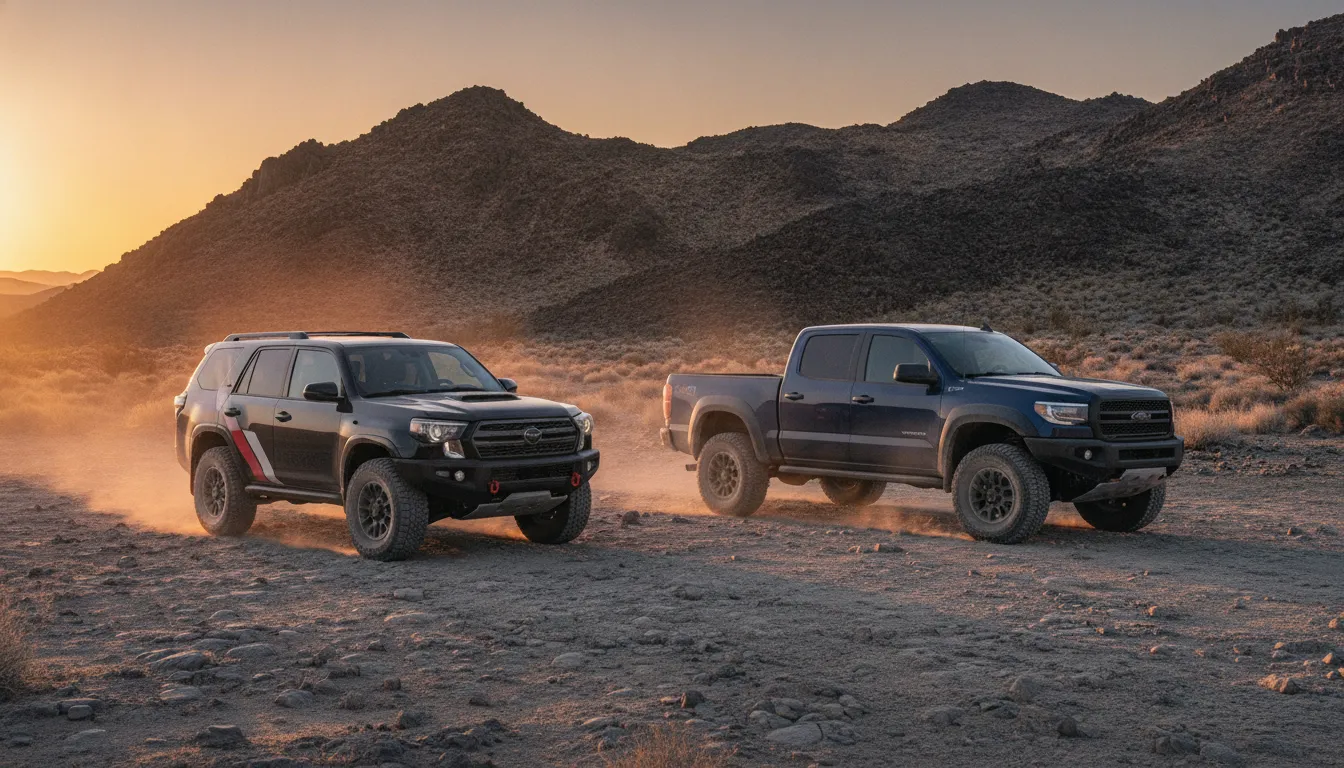
Desert driving is not one challenge. A Fort Irwin commute, a graded road near Barstow, and a rocky trail each place different demands on a vehicle. The best choice balances clearance and traction with passenger space, cargo room, ride comfort, and the work your vehicle handles between weekend trips.
The best off-road suv for desert driving depends on where you go and how you use it. Start by matching the vehicle to your terrain, then compare 4WD or AWD capability, tires, clearance, recovery needs, and everyday practicality. The National Park Service notes that desert roads can be narrow, sandy, rocky, and winding, and that not every vehicle is suitable for off-pavement travel. Learn more about desert driving safety from the NPS.
That approach gives shoppers across the High Desert a better starting point than choosing by appearance or badge alone. Before comparing SUVs and trucks from Toyota, Nissan, Jeep, or RAM, consider the conditions that define your regular routes and what a good fit needs to handle.
What Makes a Vehicle a Good Choice for High Desert Driving?
A good High Desert vehicle starts with the roads you will actually drive, not an off-road badge alone. Around Barstow, Fort Irwin, and Victorville, a vehicle may spend most of its time on pavement before reaching a sandy, rocky, narrow, or winding route. The National Park Service notes that unpaved roads vary in difficulty and that not every vehicle is appropriate for off-pavement travel. Review its desert driving guidance before planning a trip.
Start with clearance and traction
Ground clearance helps reduce the risk of striking the underside on ruts, rocks, and uneven road beds. The National Park Service specifically recommends staying on established roads and using a high-clearance vehicle for desert travel. That does not mean maximum clearance is necessary for every buyer. A commuter who occasionally uses maintained dirt roads may value easier entry, a quieter ride, and simpler everyday handling more than a highly specialized trail setup.
Traction matters when loose sand or mud reduces grip. If a route can include deep sand or mud, four-wheel drive capability and a suitable operating system may be useful, but technique still matters. The National Park Service advises engaging four-wheel drive before entering deep sand or mud, rather than waiting until the vehicle is already struggling. It also warns that excessive throttle can spin the tires and dig the vehicle in deeper. Ask how the system works, when it should be engaged, and whether its controls make sense for your experience.
Look beyond the drivetrain
Tires are part of the vehicle's contact with the terrain. Street-oriented tires may be less appropriate for rocky routes, where the National Park Service reports that rocks can damage tires rated only for street use. Ask what the current tires are designed to handle, how much pavement you drive, and whether you are prepared to replace or repair them after rough use. A tire that suits regular highway commuting may be a better daily choice than an aggressive setup if trail driving is occasional.
Recovery planning is equally important. Desert travel can involve sand, mud, high-centered vehicles, flats, or mechanical breakdowns. The National Park Service emphasizes that appropriate vehicles, working equipment, and adequate supplies are critical. Consider whether you can carry water, basic recovery equipment, and emergency supplies without sacrificing passenger or cargo space. Know that remote travel may require self-rescue, not an immediate tow or roadside response.
Finally, match capability to ownership. Compare passenger room, cargo access, visibility, ride comfort, maneuverability, maintenance needs, and highway use alongside clearance and traction. The right choice for a Fort Irwin commute and weekend dirt roads may differ from the right choice for demanding trails. Verify current trim features, tires, inventory, and pricing before choosing among Toyota, Nissan, Jeep, or RAM options.
How Do You Choose the Best Off-Road SUV for Desert Driving?
There is no single SUV that is right for every High Desert driver. A vehicle that feels at home on demanding trails may be less comfortable for a Fort Irwin commute. While a family crossover may be a better fit for paved roads and occasional dirt access. Start with how often you leave the pavement, how many people and how much cargo you carry, and whether trail capability or everyday ease matters most.
Desert roads can be narrow, sandy, rocky, and winding, and unpaved routes vary in difficulty. The National Park Service cautions that not every vehicle is appropriate for off-pavement travel, so the category is only a starting point. Review the exact vehicle, drivetrain, tires, clearance, and equipment before buying or planning a remote trip. Read the National Park Service desert driving guidance before heading out.
| Category. | Good fit for. | Potential strengths. | Tradeoffs to consider. | Questions to ask. |
|---|---|---|---|---|
| Trail-focused SUV | Frequent trail use, rocky routes, sand, and buyers who prioritize off-pavement control. | Purposeful off-road design, useful clearance, and equipment that may support more demanding terrain. | Ride comfort, cabin quietness, cargo flexibility, and highway manners can vary by vehicle and configuration. | Will I use its trail capability often? What equipment and tires are included on this exact vehicle? |
| Midsize SUV | Mixed highway commuting, family travel, dirt roads, and occasional recreation. | Often balances passenger space, maneuverability, daily comfort, and useful capability. | Space, clearance, and trail equipment may not match a vehicle designed primarily for difficult terrain. | Does it fit my passengers and cargo? Is the selected configuration appropriate for my usual roads? |
| Full-size SUV | Larger families, substantial cargo needs, long drives, and buyers who value interior room. | More passenger and cargo space can make family travel and gear transport easier. | Greater size may make narrow trails, tight turns, parking, and some technical routes more challenging | How often will I use the third row or extra cargo room? Can I comfortably place it where I plan to drive? |
| Crossover | Primarily paved commuting with graded dirt roads, camping access, or occasional unpaved travel. | Daily comfort, easy maneuverability, and practical passenger space for ordinary driving. | Capability may be limited on deep sand, rocky routes, uneven surfaces, or trails that require specialized equipment. | What roads will I actually drive, and does the vehicle have the clearance, tires, and traction system for them? |
Compare the lineup to your actual routine
Mojave Auto Group gives shoppers in Barstow and the surrounding High Desert access to Toyota, Nissan, Jeep, and RAM lineups. Depending on the vehicle and current configuration, shoppers may compare options such as the Toyota 4Runner, Land Cruiser. Sequoia, RAV4, and Highlander, Nissan Pathfinder, Rogue, and Murano, or Jeep Wrangler, Grand Cherokee L, Cherokee, and Compass. Confirm current trims, features, pricing, and availability before treating any model as a match.
For a buyer who regularly visits remote desert roads, vehicle preparation matters as much as the badge. The National Park Service recommends appropriate equipment in good working order and adequate supplies, and notes that sand, rocks, uneven road beds, and mechanical problems can create trouble. Choose the category that supports your real use, then inspect the exact vehicle rather than assuming every version performs the same way.
Are Trucks Better for Desert Trails and High Desert Work?
A truck can be a strong fit when your High Desert driving includes tools. Camping equipment, bulky cargo, or work materials that you would rather keep out of the passenger cabin. The open bed also gives you flexibility for weekend projects and recreation. However, a truck is not automatically the best choice for every trail or commute. The right decision depends on how many people you carry, how often you leave pavement, and whether maneuverability matters more than bed space.
Where a pickup makes sense
For work around Barstow, Fort Irwin, Victorville, or other High Desert communities, a pickup can balance daily transportation with practical hauling. A crew-cab configuration may provide useful passenger space for a family or work team, while the bed handles gear, tools, coolers, or materials. That separation can be especially helpful after a dusty trip or jobsite visit.
Pickups also offer a useful platform for matching equipment to the terrain. Ground clearance, tire selection, traction systems, and the availability of four-wheel drive matter more than the truck's appearance. The National Park Service notes that desert roads can be narrow, sandy, rocky, and winding, and that not every vehicle is suitable for off-pavement travel. Check the vehicle's actual configuration and intended use before choosing a trail route. Read the NPS desert driving guidance before traveling into remote terrain.
Tradeoffs to consider
A pickup's longer body and bed can make tight turns, narrow washes, and parking more challenging than they would be in a smaller SUV. The bed may also leave cargo exposed to weather and dust unless you add a cover or storage system. If most trips involve school runs, highway commuting, and passengers rather than hauling, an SUV may use interior space more efficiently.
Desert travel can also be harder on a vehicle than ordinary pavement. The NPS reports that sand is a common cause of vehicle rescues, while rocks can damage tires intended only for street use. A suitable truck still needs properly maintained equipment, appropriate tires, and responsible driving technique. More capability does not replace route planning or recovery preparation.
Truck lineups to compare
Mojave Auto Group represents truck lineups including the Toyota Tacoma and Tundra, Nissan Frontier, Jeep Gladiator, and RAM 1500. They serve different kinds of truck shoppers, so compare cab layout, bed usefulness, visibility, turning space, ride comfort, storage, and the features included on the exact trim. Confirm current availability and equipment rather than assuming every version is configured for demanding trails.
For a buyer seeking the best off-road SUV for desert driving, a truck may be the better answer when cargo and work needs lead the decision. If passenger comfort, enclosed storage, and easier maneuvering are priorities, compare SUVs before settling on a pickup.
How Should You Match 4WD, AWD, Tires, and Clearance to Terrain?
Start with the terrain you will actually drive, not the most aggressive vehicle on a brochure. A Fort Irwin commute with occasional graded dirt roads calls for a different setup than repeated trips through deep sand, rocky two-track routes, or uneven desert roads. The National Park Service recommends a high-clearance vehicle for travel on established desert roads. And notes that unpaved roads vary in difficulty, so not every vehicle is appropriate for every route.
Choose the drivetrain for the conditions
Four-wheel drive, or 4WD, generally sends power to both axles through a system designed for low-traction surfaces. Depending on the vehicle, selectable 4WD can include a low range for controlled movement through demanding terrain. It is most useful when you can engage it before entering deep sand or mud. The National Park Service specifically advises drivers to engage four-wheel drive before entering those conditions, rather than waiting until the vehicle is already struggling.
All-wheel drive, or AWD, typically manages traction automatically and is often convenient for changing conditions, wet pavement, gravel, and moderate dirt roads. It can be a practical choice for a daily driver that spends most of its time on pavement. AWD is not a guarantee of trail capability, however. Check the vehicle's clearance, tire design, suspension protection, drive modes, and the type of roads you intend to use. A system that works well on a sandy access road may not be intended for deep sand or technical rock.
Do not overlook tires and clearance
Tires are the vehicle's contact with the surface. Street-focused tires may be comfortable and quiet on a highway, but rocks can damage tires rated only for street use. All-terrain tires may offer a more suitable balance for drivers who divide time between pavement, gravel, and desert roads. The right choice still depends on the vehicle, tire load rating, weather, and the specific route. Never treat a tire label as a substitute for route planning or proper inflation guidance.
Ground clearance helps reduce the chance of striking the underside on ruts, rocks, and uneven road beds. Also consider approach, breakover, and departure angles. These describe how easily the front, middle, and rear of a vehicle can pass over an obstacle without making contact. A vehicle can have useful clearance yet still be vulnerable if a low bumper, step, hitch, or underbody component reaches an obstacle first. The NPS reports that vehicles can become high-centered on uneven road beds, making clearance and careful line selection important.
Match capability to your real route
Desert roads may be narrow, sandy, rocky, and winding. In sand or mud, excessive throttle can spin the tires and dig the vehicle in deeper, so smooth power matters as much as hardware. Before choosing, ask whether you need occasional unpaved-road access, frequent trail travel, or a vehicle for more demanding terrain. Then compare current Toyota, Nissan, Jeep, and RAM options by verified equipment and daily comfort. You can shop vehicles in Barstow and confirm current trims and features with Mojave Auto Group.
Whatever you choose, the National Park Service emphasizes that appropriate equipment in good working order and adequate supplies are critical. Vehicle capability supports a desert trip, but it does not replace checking conditions, knowing the route, and driving within the vehicle's limits.
What Should High Desert Drivers Carry Before Leaving Pavement?
A capable vehicle is only part of desert preparation. Roads around the High Desert can change from firm to sandy, rocky, narrow, or uneven. And a route that looks manageable on a screen may have limited services or unreliable coverage. Before leaving pavement from Barstow, Fort Irwin, or another nearby community, use this practical checklist.
- Check the route, road conditions, and vehicle requirements. Review the latest park, land-management, and road information before departure. The National Park Service advises checking current road conditions and vehicle requirements, and notes that travel in Mojave National Preserve can require specialized vehicles, equipment, and planning. Do not move barricades or bypass signed or coned-off closures. Review the NPS off-pavement travel guidance before you go.
- Plan fuel conservatively. Identify fuel stops before entering a remote area and start with an appropriate fuel level for the route, weather, terrain, and possible delays. Mojave National Preserve does not sell gasoline within the preserve, so do not assume a convenient refill will be available.
- Carry water and emergency supplies. Bring plenty of drinking water along with food, first-aid supplies, sun protection, extra clothing, and other essentials suited to the trip. The NPS specifically recommends drinking water and emergency supplies for sand and mud travel. Remote desert driving requires self-reliance and the ability to self-rescue.
- Bring recovery equipment that matches the vehicle and terrain. Consider traction boards or other solid materials, a properly rated recovery strap, a shovel, gloves, and a tire repair or inflation kit. Sand is a major cause of vehicle rescues, while rocks can damage tires designed only for street use. Mud, uneven road beds, high-centering, and mechanical breakdowns are additional risks, so carry equipment you know how to use.
- Use navigation and communication backups. Download route information before leaving and carry a paper map or atlas. The NPS warns that GPS navigation apps may not work reliably in the preserve and that cell coverage can be spotty. Tell someone your route and expected return, then avoid relying on a phone as your only communication method.
- Inspect the vehicle before departure. Check tire condition and pressure, spare-tire readiness, fluids, battery, belts, lights, and recovery points. Confirm that four-wheel drive engages correctly before entering deep sand or mud. Use smooth inputs rather than excessive throttle, which can spin the tires and dig the vehicle in deeper. Appropriate equipment in good working order, plus adequate supplies, is critical for desert travel.
How Do You Choose an Off-Road Vehicle You Can Live With Every Day?
The vehicle that performs well on a weekend trail also needs to fit the rest of your week. For High Desert shoppers, that may mean a commute between Barstow and Fort Irwin. School or family trips, highway travel to Victorville, and occasional dirt roads or desert recreation. Start by describing your normal day, then identify the off-road capability you will actually use. A vehicle that matches your routine is usually a better choice than one selected only for its appearance or maximum trail image.
Start with passengers, cargo, and comfort
Count the people you regularly carry, including child seats, passengers in the back row, and anyone who needs easy entry. Then consider the cargo that stays in the vehicle: groceries, work equipment, camping supplies, or recovery gear. A smaller SUV may be easier to park and maneuver during a daily commute. While a larger SUV or truck may provide more useful room for family travel and equipment. Those advantages can come with tradeoffs in garage fit, turning space, ride feel, and fuel use.
Comfort matters when an off-road vehicle spends most of its time on pavement. Pay attention to seating position, visibility, cabin noise, storage, climate-control access, and how easily passengers can get in and out. During a test drive, use the same roads you normally travel when possible. Check whether the vehicle feels manageable in traffic and whether the seating and cargo layout work for your household, not just for a short demonstration.
Account for the Fort Irwin commute and desert conditions
Drivers near Fort Irwin may need a vehicle that handles long highway stretches before reaching unpaved roads. Think about how often you leave pavement, whether your routes include rough washboard surfaces or loose sand, and whether you travel alone or with a full cabin. Toyota, Nissan, Jeep, and RAM each offer lineups that may fit different combinations of commuting, family use, work, and recreation. The right comparison depends on the specific vehicle, drivetrain, tires, clearance, equipment, and condition, so confirm those details rather than assuming every off-road package serves the same purpose.
Fuel use is also part of daily ownership. You do not need a precise estimate to make the question useful. Compare how much of your driving is commuting, how often you carry heavy loads, and how much capability you are willing to accept for occasional trail use. If most trips are paved, avoid paying for size or equipment that does not solve a real need. If desert travel is frequent, prioritize the controls, traction, protection, and tire setup that support your routes.
Consider used and certified pre-owned options carefully
A used or certified pre-owned vehicle can expand the range of vehicles you can evaluate, but condition matters especially when a vehicle may have traveled off pavement. Ask for maintenance records and inspect the tires, underbody, suspension, steering, recovery points, and signs of collision or water damage. During a drive, listen for unusual noises, confirm that warning lights operate normally, and test the features you expect to use. Manufacturer-certified vehicles may include certification and warranty coverage where applicable, but the exact inspection, coverage, and terms should be confirmed before purchase.
You can browse used off-road vehicles and then ask the dealership to verify current equipment, history, availability, and vehicle-specific details. Financing can also change the practical fit of a purchase. Compare the payment structure, down payment, term, eligibility, and total ownership budget rather than focusing on a single monthly figure. Whether you choose a new, used, or certified pre-owned vehicle, bring your real passenger, cargo, commute, and terrain requirements to the conversation.
Frequently Asked Questions
What is the best off-road vehicle for desert driving?
There is no universal winner. The best choice depends on how often you leave pavement. How many passengers and how much cargo you carry, and whether the vehicle must also handle a daily commute. Compare ground clearance, traction systems, tire type, recovery needs, comfort, and maneuverability, then verify the exact trim and equipment. For Mojave National Preserve travel, the National Park Service recommends a high-clearance vehicle and notes that not every vehicle is suitable for off-pavement roads: NPS vehicle guidance.
What is the best SUV for both off-roading and highway driving?
Look for a vehicle that provides the capability your trails require without creating unnecessary compromises on pavement. A midsize SUV may offer a useful balance of passenger space, cargo room, visibility. And trail maneuverability, while a more trail-focused SUV may make sense for frequent demanding routes. Test the seating, ride comfort, cargo access, and highway noise, and confirm that the available tires and drive system match your intended terrain.
Is 4WD or AWD better in sand?
It depends on the system, vehicle, tires, driver technique, and sand conditions. For deep sand, the National Park Service advises engaging four-wheel drive before entering and using smooth power rather than excessive throttle. Which can spin the tires and dig the vehicle in deeper: NPS sand-driving tips. Review the owner's manual and practice using the system before a remote trip.
How do I choose the right desert SUV or truck for my needs?
Start with your real use case. A commuter who occasionally reaches an unpaved road may prioritize comfort, cargo flexibility, and everyday efficiency. A frequent trail driver may place more emphasis on clearance, tires, traction, and recovery planning. Families and Fort Irwin-area commuters should also consider passenger space, child-seat fit, visibility, and service access. Compare Toyota, Nissan, Jeep, and RAM options in the relevant body style, then confirm current inventory, features, pricing, and terms before deciding.
Get started with your High Desert vehicle search
The right off-road SUV or truck should fit both your desert plans and your everyday routine in Barstow, Fort Irwin, or the surrounding High Desert. Browse current options, then confirm the available trims, features, vehicle condition, and terms before making a decision. To get started, apply for vehicle financing with Mojave Auto Group and take the next step toward a vehicle matched to your needs.